Mitigating the impact of HABs on aquaculture
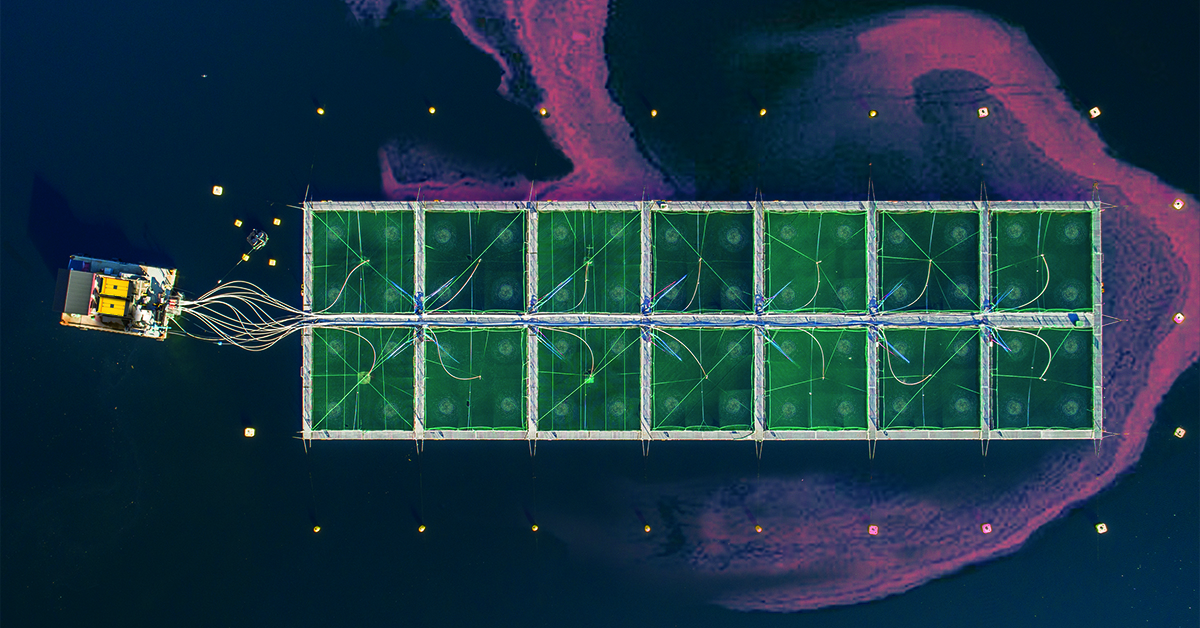
Compressed air is playing a pivotal role in the systems being used to mitigate the impact of Harmful Algae Blooms (HABs) on fish stock.
From rising ocean temperatures to a higher CO₂ content of the atmosphere and eutrophication, Harmful Algae Blooms (HABs) have become more intense and frequent in recent years. For the aquaculture industry, if left unmanaged, HABs can lead to mass fish mortalities.
What impact do HABs have on aquaculture?
When it comes to the impact of HABs on aquaculture the results can - and have proven to be - devastating.
Firstly HABs deplete the O₂ levels in the water in a number of ways:
- Algae consume O₂ during the night which can reduce the O₂ content of the water
- The algae that dies off are decomposed by bacteria. In this process the bacteria also depletes O₂ levels
- In addition, certain species of algae in high numbers can block the fishes gills which hinders them in being able to take up O₂
For the fish, depletion of O₂ levels can cause stress or even mortality - especially salmonids like salmon which require a high O₂ content.
Secondly, some HABs produce toxins which are harmful - if not deadly - to aquatic organisms.
So how can aquaculturists mitigate HABs?
The Upwelling system
An upwelling system works on the principle that microalgae are buoyant and therefore only present in the top layer of the ocean. Therefore this system creates an artificial upwelling of cold, O₂ rich water that doesn't contain phytoplankton.
This is created by an air compressor that pumps air through either a single - or multiple - diffuser(s) into the sea pens.
The air is often injected at depths of 15 to 30 metres. Through the injection of small air bubbles, the density of the water in the depths is lowered, which makes the water rise.
When the water with the lower density hits the surface, it spreads out to the sides. By spreading out to the sides, it pushes the surface water outwards and with it the harmful algae. If controlled well, the fish will never be in contact with the algae bloom, as the air is constantly pumped into the sea pens.
Benefits of aeration
Aside from mitigating stock losses due to HABs, aeration has a number of additional benefits:
- By bringing up water from the depths, warm water temperatures are cooled down. Generally speaking, cold water contains more O₂ than warm water. By increasing the O₂ content of the water, the Feed Conversion Ratio can be lowered which means less feed for 1 kg of growth therefore generating cost savings.
- Many farmers use ‘lice skirts’ to prevent lice from entering the sea pens. These skirts block the waterflow, which can lead to low O₂ conditions. Aeration can also solve the issue, as the upwelling system brings O₂ rich water from the depth inside the skirted zone.
- An upwelling system creates a water current which makes the fish more active (e.g. they swim more). This exercise makes the fish leaner (e.g. they carry less fat).
- Finally, the upwelling system pushes out other marine animals that are planktonically floating in the top layer of the water. This includes jellyfish, which are known to cause mass mortalities.
Bubble curtain
Combining an upwelling system with a bubble curtain presents another mitigation system option.
An upwelling system can only stop algae on the top layer of the pens due to the water movement. This means that only algae in the photic zone will be pushed out. To protect the entire water column a bubble curtain would be added.
Here, a compressor pumps air into a diffuser hose which surrounds the entire farm at its lowest point.
The bubble curtain this creates all around the farm acts as an underwater wall and stops particles drifting along with the current from entering the farm.
The suitability of these mitigation system solutions will depend on a farm's specific conditions and should be assessed case by case.
For example, in some areas deep water can potentially have lower O₂ levels in which case an air driven upwelling system would not be the right choice. Here, increasing the O₂ content would be done by injecting pure O₂. Another example is sites with strong currents which have the potential to eradicate the effectiveness of these mitigation systems.
AI - the holy grail of mitigation systems
In order to keep fish stock as healthy as possible and for these mitigation systems to be effective, measures need to be taken before a HAB hits the farm.
Thanks to AI (artificial intelligence), it is now possible to predict algae blooms.
By implementing AI based monitoring systems that measure water temperature at different levels, that monitor water quality - and by regularly analysing water samples under the microscope - aquaculturists are able to determine types and density of algae present. And, such a large amount of data makes it possible to then learn and predict blooms in the future.
When these systems are set up to connect with the control systems on the compressors, it’s also possible to start-up the mitigation systems early enough to prevent stress and losses in the stock.
Such a combination makes it possible to save large amounts of money thanks to the accurate use of the system, controlled by sensors and a multitude of water parameters.
Get In Touch With HPC Today
Do you need help finding the right air compressor solution or compressed air system for your business?
KAESER Compressors
HPC has solely represented the comprehensive KAESER range of quality, energy efficient air compressors and compressed air equipment in the UK for over 40 years.
OUR NETWORK
We support a network of distributor partners across the UK and ensure that professional, experienced customer support is available both nationally and locally.