Compressed air applications in industrial yeast production

The crucial role of reliable and energy-efficient blower and compressed air solutions
Many processes in industrial yeast production require the use of low-pressure or compressed air.
One of the most important processes is large-scale fermentation (the cultivation process).
Here, fans must reliably aerate and stir the yeast mixture to achieve optimal yields. Aeration can account for up to 50% of a yeast factory's total energy consumption.
Therefore, the reliability and energy efficiency of the fans are crucial to keeping production costs per ton of yeast as low as possible.
In this article, we examine typical applications of low-pressure and compressed air in yeast production and demonstrate how HPC KAESER's advanced solutions meet these requirements.
Typical compressed air applications in yeast production
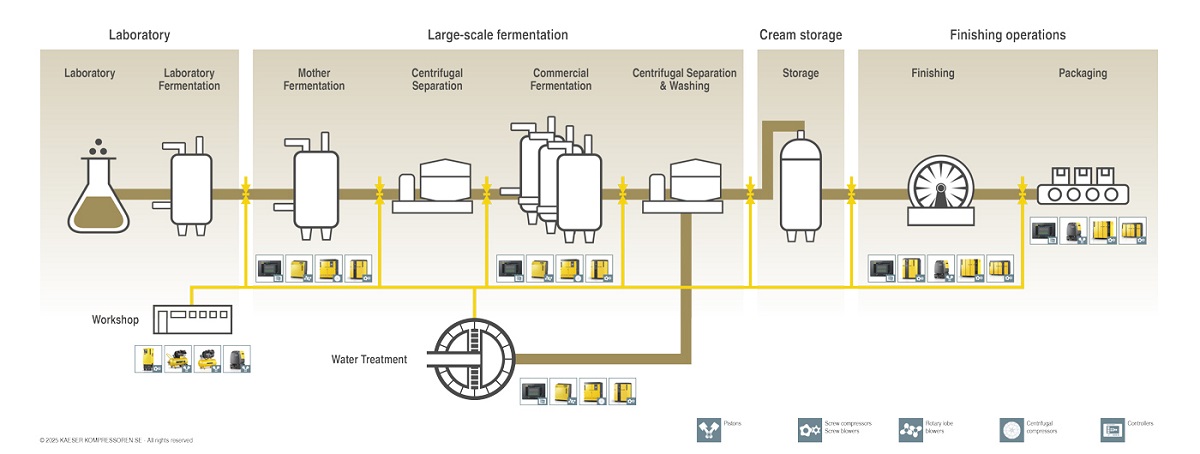
Intelligent HPC KAESER compressed air solutions in use in industrial yeast production
Download
The above diagram can be downloaded as a PDF file here.
Large-scale fermentation

Large-scale fermentation (aerobic cultivation) is a crucial process for producing yeast , which is needed in the food industry, for example, for bread making. From the mother ferment to commercial fermentation, low-pressure air is essential throughout the cell growth process in large-volume fermentation tanks.
Fans aerate and mix the yeast mixture in the fermenters. Aeration supplies the yeast cells with oxygen, while mixing ensures homogeneous conditions and improves mass transfer. Yeast is typically produced using a fed-batch process.
This means that after an initial start-up phase, substrate is continuously fed into the bioreactor to avoid a very high sugar concentration at the beginning.
Excessively high sugar concentrations would inhibit yeast cell growth. The addition of substrate causes the volume of the bioreactor contents to continuously increase. To ensure a consistent oxygen supply, the blower system must therefore adapt to the constantly changing situation, i.e., increase the pressure to compensate for the larger volume and increase the delivery rate to provide a sufficient amount of oxygen to supply the growing number of yeast cells. The goal of fermentation is to keep the yeast cells in the exponential growth phase. Controlling fermentation with an optimal substrate supply and the associated aeration is essential to achieve optimal yeast production results.
In particular, the fan must adapt instantly to the constantly changing process parameters. Too little or too much ventilation can lead to product spoilage, and disposing of the spoiled batch, cleaning the fermentation vessels, and restarting the production process can be time-consuming, resource-intensive, and energy-intensive.
The aeration requirements of a large-scale fermentation are typically one of the largest energy consumers in a biotechnology production facility, accounting for up to 50% of the plant's total energy consumption. A reliable and efficient supply of low-pressure air is therefore crucial not only for the success of the aerobic process but also for the overall energy consumption of the aeration fans .
HPC works closely with its customers to deliver high-performance blower systems for optimal aerobic fermentation results, maximum efficiency, and low energy consumption. To achieve peak performance with a multi-blower station, the SIGMA AIR MANAGER 4.0 can be integrated, which dynamically adjusts blower operation based on real-time air flow and pressure requirements to ensure optimal low-pressure air production at all times.
Learn more about HPC KAESER solutions for large-scale fermentation:

Final processing of yeast
Ultra-pure instrument air, which typically requires a pressure of 6-7 bar(g), is essential for controlling valves and operating pneumatic devices in an industrial yeast production facility. In particular, it is required for several finishing processes:
Operation of drying plants
Due to their simplicity and effectiveness in removing moisture, fans are often used in the drying process for dry yeast production. However, there are alternative drying methods that use compressed air and offer better drying efficiency and product quality, such as:
- Fluidized bed drying: this method uses compressed air to liquefy the yeast particles and ensure uniform drying. Consistent airflow is critical for maintaining consistent drying conditions and optimal drying temperatures, thereby improving the overall efficiency of the drying process.
- Spray drying: this method requires compressed air to atomise the yeast cream into fine droplets. Clean, dry compressed air is crucial for efficient drying and uniform droplet size, which contributes to the quality of the final product.
Vacuum conveying is used once the yeast is dried to gently and efficiently transport the dried yeast from the drying facility to packaging without compromising its integrity. This type of pneumatic conveying during the dilution phase requires high-velocity, low-pressure compressed air to effectively transport the yeast. For optimal performance, the compressed air must be free of moisture and oil to avoid disruptions to material flow and system efficiency, as well as contaminants.
As with all compressor and blower applications in industrial yeast production, clean, dry compressed air is essential to meet the stringent air purity requirements of food production. Working closely with process equipment manufacturers and applying relevant standards such as ISO 8573-1, KAESER offers customized blower and compressed air system solutions that reliably and efficiently meet the stringent air quality standards for industrial yeast processing.
Learn more about HPC KAESER solutions for yeast final processing:
- Screw Blowers
- Oil-Free Screw Compressors
- Medium Screw Compressors from 18.5 to 315 kW
- Large Screw Compressors from 360 to 515 kW
- Oil-free Workshop Compressors
- Compressed Air Management System
Packaging of yeast

Instrument air is required for the final packaging of the yeast – from driving the pneumatic actuators that power the mechanical movements of the packaging machines to preventing contamination in the filling and capping mechanisms.
This can also include driving air knives or blow-off devices used to blow off excess yeast particles and maintain cleanliness, for example, of packaging materials or machine surfaces. Such applications rely on a reliable supply of clean, dry compressed air to ensure cleanliness and prevent contamination.
HPC works with packaging machine OEMs and customers to identify and deliver the optimal compressor or blower solution tailored to the specific requirements of packaging equipment while meeting the required cleanliness classes according to ISO 8573-1.
Learn more about KAESER solutions for yeast packaging:
- Oil-Free Screw Compressors
- Medium Screw Compressors from 18.5 to 315 kW
- Large Screw Compressors from 360 to 515 kW
- Oil-free Workshop Compressors
- Compressed Air Management System

Operational water treatment
Low-pressure air—and in some cases, compressed air—is critical for on-site water treatment. In the biological treatment stage, for example, low-pressure air is needed to aerate the wastewater. Blowers generate airflow for aeration systems, which create fine air bubbles that are injected into the wastewater.
This aeration provides the bacteria with the oxygen needed to decompose organic matter.
Yeast wastewater typically has a high biological oxygen demand (BOD) due to its high content of sugars, proteins, and yeast residues. This means that a significant amount of oxygen is required to support microbial activity for the biological treatment process.
Adequate oxygen supply is therefore crucial for maintaining effective microbial activity, which means that the performance of the blowers directly influences the treatment success.
Industrial yeast production consumes large amounts of water, with plants consuming thousands of liters daily. Furthermore, aeration is a major energy consumer in wastewater treatment. Effective and energy-efficient on-site water treatment is therefore essential not only for sustainable water management but also for optimized energy use. Therefore, the selection of reliable and energy-efficient aeration fans is becoming increasingly important.
HPC offers customised blower solutions that reliably and energy-efficiently meet the aeration requirements of on-site water treatment.
Learn more about KAESER solutions for industrial water treatment:
Compressed air for the workshop

In the workshop of a yeast factory, a reliable supply of compressed air is required for various tasks, such as operating pneumatic tools and cleaning components. HPC KAESER piston compressors are the ideal solution for workshops with intermittent compressed air requirements.
The compressors are available in both mobile versions (CLASSIC and PREMIUM series) and stationary models (KCT and AIRBOX series) and impress with their flexibility and reliability. Rotary screw compressors are a highly efficient solution for larger workshops with continuous compressed air requirements. The HPC KAESER AIRCENTER series combines a powerful rotary screw compressor, a refrigeration dryer, and an air receiver in a compact, complete system.
Thanks to its quiet operation, the system is ideal for use directly at the workplace. Alternatively, the SXC series offers a space-saving, complete solution with a refrigeration dryer and compressed air receiver – housed in a robust polyethylene housing.
Learn more about KAESER solutions for the workshop:
Get In Touch With HPC Today
Do you need help finding the right air compressor solution or compressed air system for your business?
OUR NETWORK
We support a network of distributor partners across the UK and ensure that professional, experienced customer support is available both nationally and locally.
KAESER Compressors
HPC has solely represented the comprehensive KAESER range of quality, energy efficient air compressors and compressed air equipment in the UK for over 40 years.